Autonomy-in-a-Box (AiB)
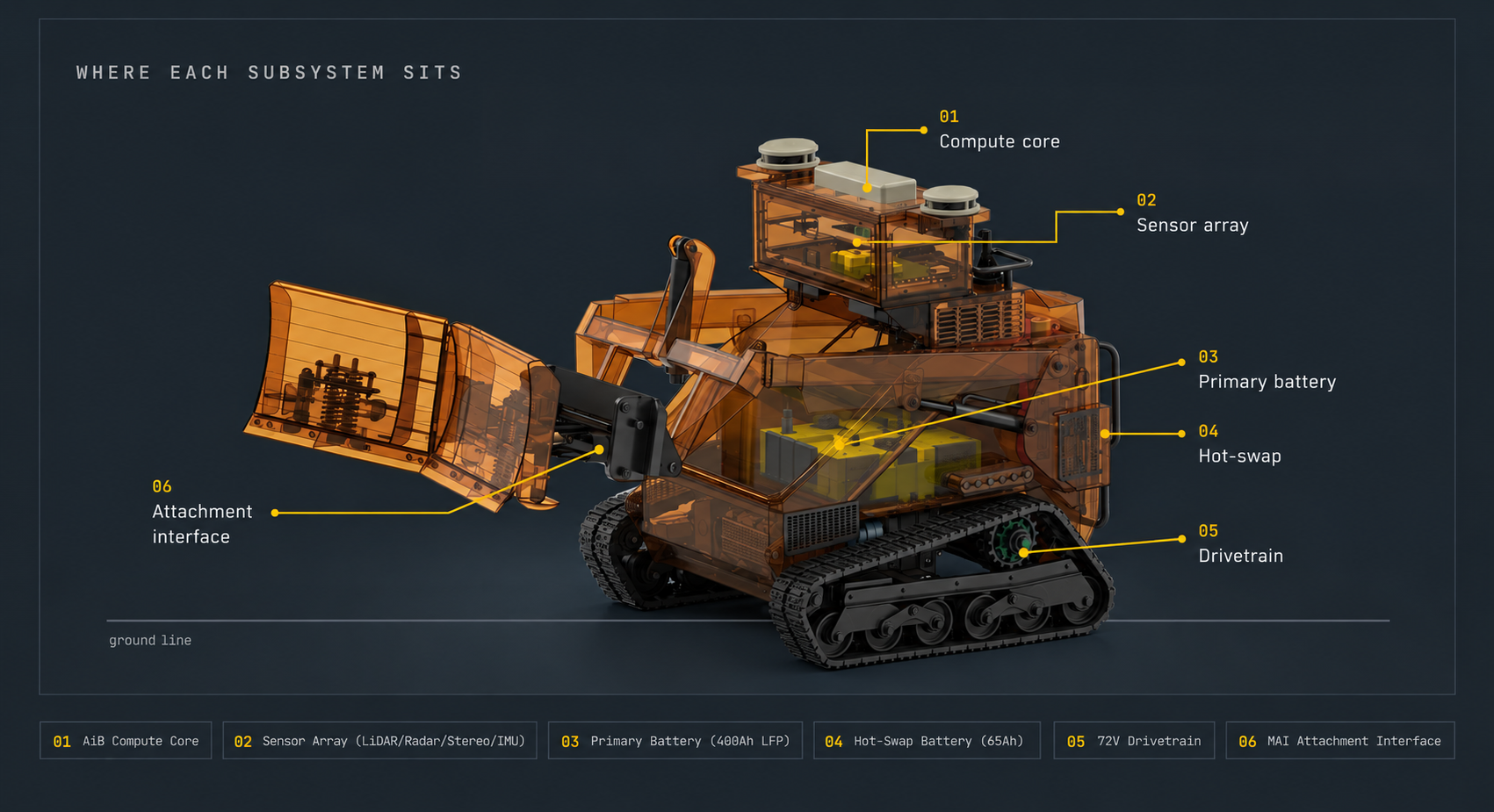
RTK GPS, LiDAR, radar, stereo vision, and IMU fused at 25Hz. ±1 inch accuracy in open terrain, GPS-denied navigation via visual odometry and inertial fallback. The complete autonomy brain.
Explore Autonomy-in-a-Box (AiB)Every subsystem in the Snowbotix SMUR X1 was designed to work as a unified whole, from the Autonomy-in-a-Box (AiB) autonomy stack to the LFP battery chemistry to the heated wireless docking infrastructure. There are no commodity-component compromises. There is one integrated system, built for one purpose.
Six Purpose-Built Subsystems
RTK GPS, LiDAR, radar, stereo vision, and IMU fused at 25Hz. ±1 inch accuracy in open terrain, GPS-denied navigation via visual odometry and inertial fallback. The complete autonomy brain.
Explore Autonomy-in-a-Box (AiB)400Ah LFP primary with active self-heating plus 65Ah hot-swap backup. Engineered for sustained −40°F operation without range de-rating under standard loads.
Explore Battery System72V high-torque architecture for maximum gradeability and traction on ice and compacted snow. Torque-first: built for load, grade, and conditions.
Explore DrivetrainChoose from 110/220V mobile charging, a fully autonomous wireless charging dock, or a premium option heated garage with wireless docking.
Explore Charging4G/5G cellular as standard, LEO satellite communication built into the Autonomy-in-a-Box (AiB) stack and provisioned per deployment, plus local Wi-Fi. 40% protocol bandwidth reduction. OTA updates and remote override, configured to the site.
Explore ConnectivityNine purpose-built attachments via the MAI tool-free interface in under 5 minutes. Forward-compatible with all SMUR X1-generation platforms, a permanent operational asset.
Explore AttachmentsThe SMUR X1's capability in extreme environments is not a function of any single technology. It is the result of six purpose-built subsystems designed to operate together under conditions that expose the weakness in any single-point approach. The Snowbotix technology stack is the integration itself.
System Integration
The Autonomy-in-a-Box (AiB) is not a navigation module bolted to an otherwise conventional machine. It is the operational intelligence layer of a system designed with shared awareness of every other subsystem: battery state, attachment type, environmental conditions, geofence boundaries, operator-defined safety zones, and connectivity quality all feed the Autonomy-in-a-Box (AiB)'s continuous planning loop.
When the SMUR X1 detects a battery state that requires early docking, it doesn't pause and alert an operator. It re-routes autonomously, completes a compressed mission covering priority zones, docks, and logs the deviation with its justification in the proof-of-service record. This is not automation. This is supervised autonomy at a system level.
System Integration Diagram
Four things happen. Every pass, every time.
A person is always in charge.
Watch, pause or stop it at any time. If it loses signal it finishes the route: the connection carries the record out, not the commands in.