Cell Balancing
Active balancing during charge and discharge maintains voltage uniformity across the 400Ah pack. Unbalanced packs age disproportionately, so continuous balancing protects long-term cycle life at the cell level.
Cold-weather battery performance is the unresolved problem most autonomous outdoor systems quietly avoid. Snowbotix doesn't. The SMUR X1's LFP primary system is engineered for sustained extreme-cold operation, with active self-heating that prevents cold-temperature capacity loss before it starts.
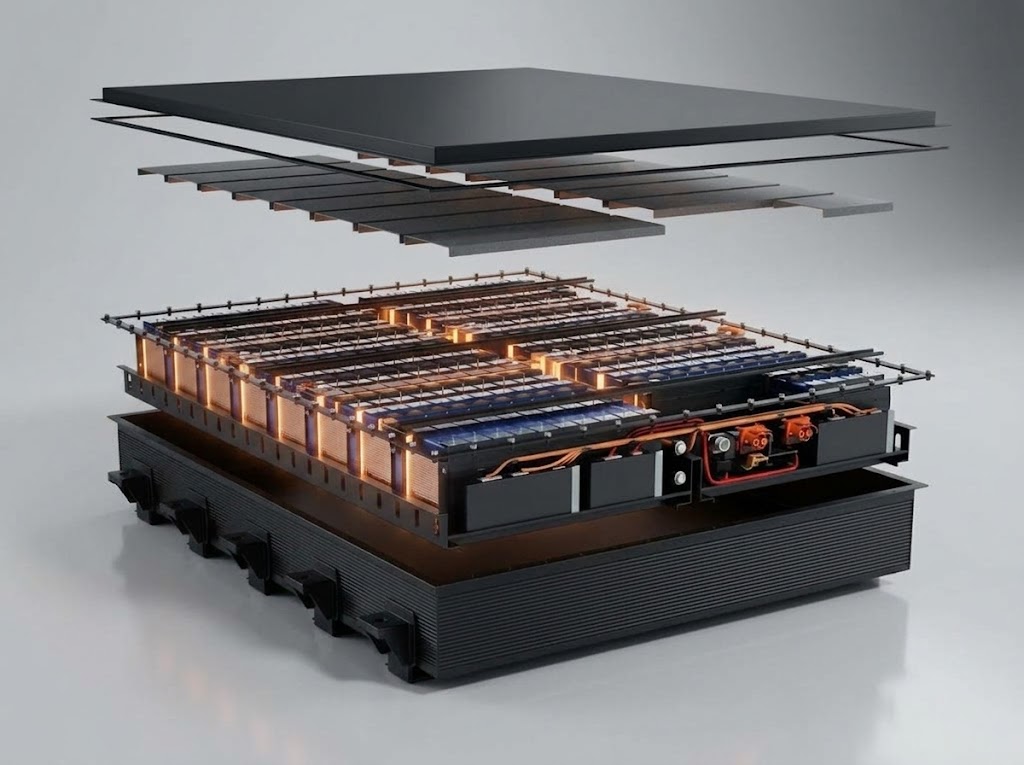
LFP Chemistry
Lithium iron phosphate was selected not because it is the highest energy-density option (it is not) but because it is the most appropriate chemistry for the environment. LFP cells have inherently higher thermal stability than NMC or NCA, so cold-temperature behavior is more predictable and manageable. At −40°F, a well-managed LFP pack with active self-heating delivers performance physically impossible for an NMC pack without the same thermal investment.
Active self-heating is not a supplementary feature. It is a core architectural element. Below a defined threshold, the BMS activates internal heating to raise cell temperature before load is applied, autonomously during pre-deployment managed by the heated dock. By the time the window opens, cells are at operating temperature and ready for full rated capacity. Cold-temperature de-rating is not a variable the operator manages.
Primary Battery
Zero-Downtime Backup Power
The 65Ah hot-swap backup is the field-deployable bridge for scenarios where the primary needs mid-mission intervention. The bay is accessible from the exterior with no tools: in snow, wearing heavy gloves, the module inserts and locks in under 5 minutes. The SMUR X1 continues from the point of interruption without losing operational state, position fix, or active route.
The backup is not a degraded mode. It is full-capability delivery at reduced capacity. The SMUR X1 runs all systems normally from the hot-swap module while the primary returns to dock. For fleet peaks where docking is impractical, hot-swap modules sustain continuous coverage.
Active Thermal Management
Passive management in extreme cold is an oxymoron: a battery that only responds to thermal stress after it occurs always delivers degraded performance. The BMS takes an anticipatory approach: self-heating activates based on cell temperature, ambient temperature, scheduled deployment time, and historical pack performance. By the time the window opens, cells are within the optimal range regardless of the overnight minimum.
Inside the heated dock, pre-conditioning begins hours before deployment. Heating elements integral to the pack structure circulate thermal energy for even cell temperature distribution. Uneven cell temperature is as damaging as average cold. This uniformity focus separates the SMUR X1 from platforms using external battery heating blankets.
Battery Management
Active balancing during charge and discharge maintains voltage uniformity across the 400Ah pack. Unbalanced packs age disproportionately, so continuous balancing protects long-term cycle life at the cell level.
Three layers: active heating below threshold, passive insulation steady-state, and thermal runaway protection. Individual cell temperatures monitored at 1 Hz with adaptive heating output.
State-of-charge, state-of-health, cell voltage distribution, and pack temperature stream to the fleet platform in real time over the deployment’s connectivity link: accurate runtime, predictive charge time, and capacity trends.